
Uncategorized
How THC Works in the Body: Understanding THC and the Endocannabinoid System
Jul
How THC works in the body is one of the most widely studied topics in cannabis science. Tetrahydrocannabinol (THC) is among the best-known naturally occurring cannabinoids found in cannabis plants, and decades of scientific research have helped researchers better understand how it interacts with the body’s biological communication systems.
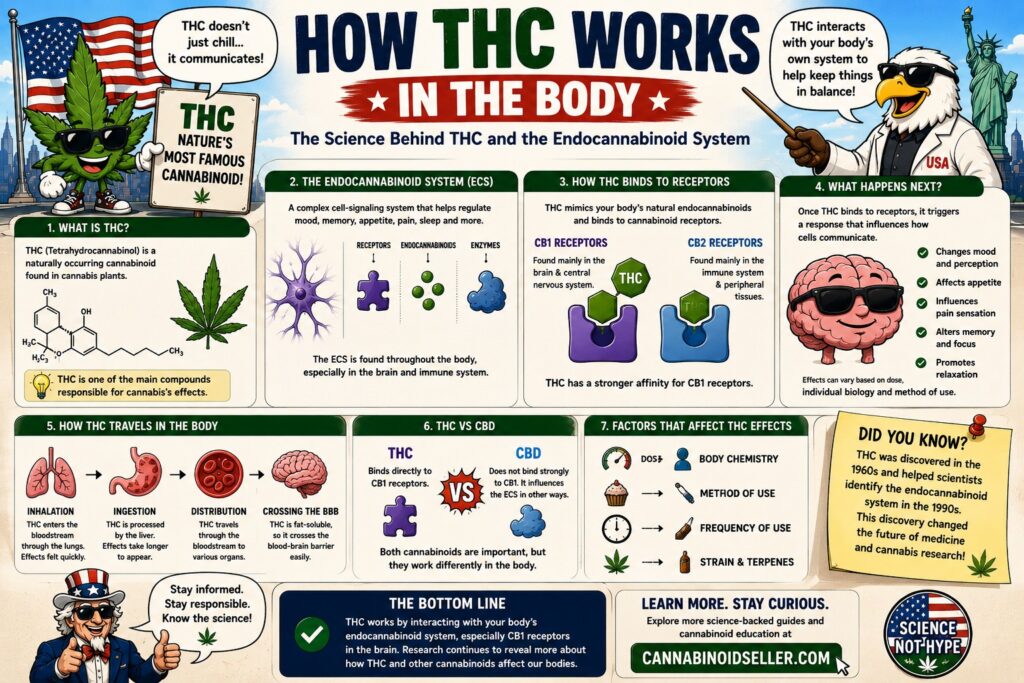
THC does not act alone. Its activity is closely connected to the endocannabinoid system (ECS), a complex network of receptors, naturally produced signaling molecules, and enzymes that help regulate communication throughout the body. Understanding how THC works in the body provides valuable insight into cannabinoid biology, receptor signaling, and the remarkable chemistry of cannabis.
As research continues across the United States, scientists are expanding their knowledge of THC, cannabinoid receptors, and the many ways cannabinoids interact with biological systems.
What Is THC?
THC, or tetrahydrocannabinol, is a naturally occurring phytocannabinoid produced by cannabis plants.
It develops through the plant’s cannabinoid biosynthesis process and is classified as one of the major cannabinoids because it naturally occurs in relatively higher concentrations than many other cannabinoids.
THC became especially important in cannabis science because its discovery helped researchers identify the endocannabinoid system and understand how cannabinoids communicate with the body.
Readers new to cannabinoid science can begin with our guide explaining What Is THC.
The Endocannabinoid System
Understanding THC begins with understanding the endocannabinoid system.
The ECS is a biological communication network composed of three primary components:
- Cannabinoid receptors
- Endocannabinoids naturally produced by the body
- Enzymes that synthesize and break down these signaling molecules
Together, these components help maintain biological communication and internal balance, also known as homeostasis.
Researchers continue studying how THC and other cannabinoids interact with this system to better understand cannabinoid signaling.
Learn more in our guide on What Is the Endocannabinoid System.
Cannabinoid Receptors and THC
THC primarily interacts with specialized proteins called cannabinoid receptors.
Researchers have identified two primary receptor types:
CB1 Receptors
CB1 receptors are found mainly in the brain and central nervous system. THC has a notable affinity for these receptors, making them a major focus of cannabis research.
CB2 Receptors
CB2 receptors occur more commonly in immune-related tissues and peripheral systems. Researchers continue studying how THC and other cannabinoids interact with these receptors as scientific understanding evolves.
For more information, read our articles on Cannabinoid Receptors Explained and CB1 vs CB2 Receptors.
How THC Binds to Receptors
Scientists describe THC as a cannabinoid that binds to cannabinoid receptors through receptor affinity.
When THC reaches compatible receptors, it participates in complex signaling processes within the endocannabinoid system. Researchers continue investigating these signaling pathways using advanced laboratory techniques, molecular biology, and neuroscience.
Understanding receptor binding has helped explain why THC became central to cannabinoid research.
Readers can explore this topic further in our guide on How Cannabinoids Interact With Receptors.
How THC Travels Through the Body
After entering the body, THC is absorbed and distributed through the bloodstream.
Its movement depends on several factors, including the method of administration, metabolism, and its lipophilic (fat-soluble) nature. Because THC is highly lipophilic, researchers have found that it can cross the blood-brain barrier, allowing scientists to study its interaction with the central nervous system.
Readers interested in this process can explore our articles on Cannabinoid Absorption and How Cannabinoids Cross the Blood-Brain Barrier.
THC Compared With CBD
THC and CBD are often discussed together because both are major cannabinoids naturally produced by cannabis plants.
Despite sharing a common origin, researchers have found that their molecular structures and receptor interactions differ. THC demonstrates stronger affinity for CB1 receptors, while CBD is believed to influence biological signaling through different mechanisms.
Learn more through our guides on What Is CBD and How Does CBD Work in the Body.
THC and Other Cannabinoids
Modern cannabis research extends well beyond THC.
Scientists continue investigating cannabinoids such as CBG, CBC, HHC, THCP, and numerous rare cannabinoids to better understand how structural differences influence receptor interactions and cannabinoid signaling.
These discoveries continue expanding scientific knowledge of cannabis chemistry and cannabinoid diversity.
Readers can continue learning through our articles on CBG Cannabinoids, What Is CBC, What Is HHC, What Is THCP, and Rare Cannabinoids.
Why Researchers Continue Studying THC
THC remains one of the most important cannabinoids in scientific research.
Its discovery helped establish the field of cannabinoid biology and contributed directly to identifying the endocannabinoid system.
Today, researchers continue investigating THC using molecular biology, neuroscience, analytical chemistry, and genetics to better understand receptor signaling, cannabinoid chemistry, and biological communication.
As technology advances, scientists expect THC research to continue providing valuable insights into cannabis science.
Looking Toward the Future
Future research involving THC will likely focus on increasingly detailed studies of receptor biology, molecular signaling, cannabinoid metabolism, and cannabinoid diversity.
New laboratory techniques continue improving researchers’ understanding of how THC interacts with biological systems and how its chemistry compares with newly discovered cannabinoids.
If you’d like to continue exploring cannabis science, read our Complete Cannabinoid Guide and visit our https://cannabinoidseller.com/ for trusted educational resources covering cannabinoids, receptors, cannabis biology, and the latest scientific discoveries.
Conclusion
Understanding how THC works in the body begins with understanding the endocannabinoid system and cannabinoid receptors. THC remains one of the most extensively researched cannabinoids because its interaction with biological signaling pathways helped shape modern cannabis science.
As researchers continue uncovering new information about THC and other cannabinoids, scientific knowledge will continue expanding and provide an even deeper understanding of the remarkable chemistry of cannabis.
Frequently Asked Questions
How does THC work in the body?
THC interacts primarily with cannabinoid receptors within the endocannabinoid system, where researchers study its role in biological signaling.
What is the endocannabinoid system?
The endocannabinoid system is a biological communication network made up of receptors, endocannabinoids, and enzymes that help regulate signaling throughout the body.
Which receptors does THC interact with?
THC is primarily studied for its interaction with CB1 receptors, although researchers also investigate its relationship with CB2 receptors.
Can THC cross the blood-brain barrier?
Yes. Researchers have found that THC’s lipophilic properties allow it to cross the blood-brain barrier, making it an important subject in neuroscience research.
How is THC different from CBD?
THC and CBD have different molecular structures and interact differently with the body’s biological signaling systems.
Where can I learn more about cannabinoids?
You can explore additional educational guides, cannabinoid research articles, and cannabis science resources by visiting our educational hub at https://cannabinoidseller.com/.
