
Uncategorized
Cannabinoid Receptors Explained: Understanding CB1, CB2 and the Endocannabinoid System
Jun
Cannabinoid receptors explained in simple terms means understanding the communication system that allows cannabinoids to interact with the human body. These specialized receptors are a central part of the endocannabinoid system, a biological network that helps regulate numerous physiological processes.
Although cannabinoids such as THC, CBD, CBG, and THCP often receive most of the attention, their interactions would not be possible without cannabinoid receptors. These receptors act as biological messengers, helping cells communicate and respond to signals throughout the body.
The discovery of cannabinoid receptors transformed cannabis science and provided researchers with a clearer understanding of how cannabinoids influence biological systems. Today, these receptors remain one of the most important areas of cannabinoid research.
The Discovery That Changed Cannabis Research
Before the endocannabinoid system was identified, researchers understood that cannabinoids produced measurable effects but could not fully explain how these compounds interacted with the body.
That changed during the late twentieth century when scientists discovered specialized receptors designed to interact with cannabinoid molecules. This breakthrough led to the identification of the endocannabinoid system, often referred to as the ECS.
The discovery revealed that the human body possesses an entire biological network dedicated to cannabinoid signaling. It also demonstrated that the body naturally produces its own cannabinoid-like compounds, known as endocannabinoids.
Understanding these receptors remains essential for anyone studying cannabis science and the broader role of cannabinoids within biological systems.
Readers who are new to cannabinoid science may benefit from exploring our What Are Cannabinoids guide before diving deeper into receptor function.
What Are Cannabinoid Receptors?
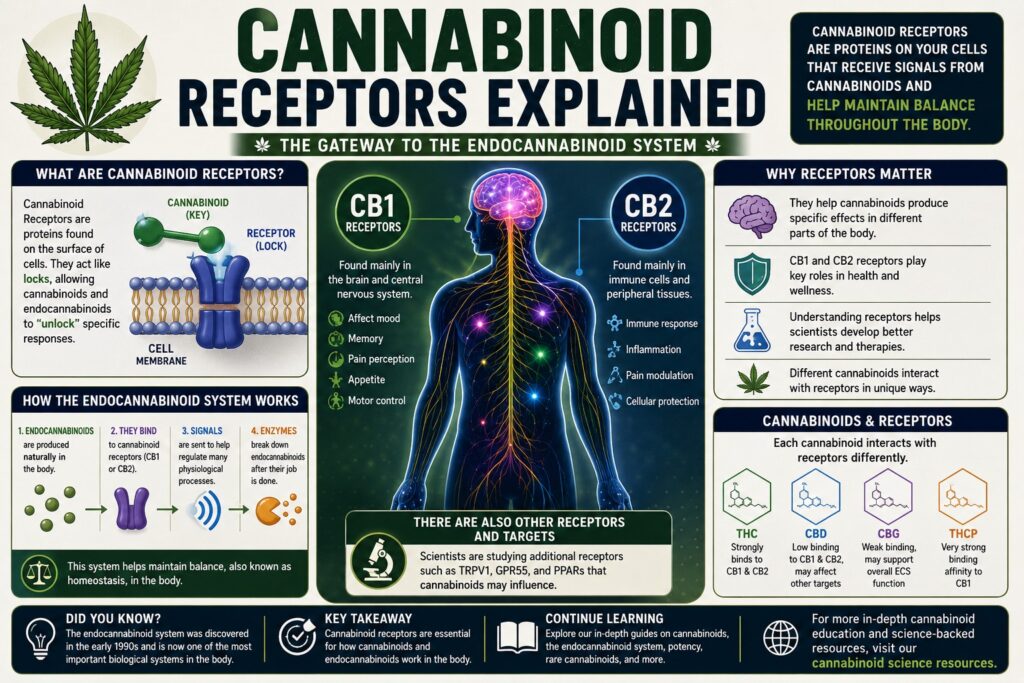
Cannabinoid receptors are proteins located on the surface of cells throughout the body.
Their primary role is to receive chemical signals and help coordinate communication between cells. When cannabinoids or endocannabinoids interact with these receptors, a series of biological responses may occur.
Researchers often describe receptors as locks and cannabinoids as keys. When the appropriate cannabinoid interacts with a receptor, the receptor becomes activated and transmits signals that influence various physiological processes.
This receptor-based communication system plays a major role in maintaining balance throughout the body.
Understanding the Two Primary Receptors
Scientists have identified two major cannabinoid receptors that receive the majority of research attention.
These receptors differ in location and function, which helps explain why cannabinoids may interact with biological systems in different ways.
CB1 Receptors
CB1 receptors are found primarily within the brain and central nervous system.
They are among the most abundant receptor types in the human body and play an important role in cannabinoid signaling. Because many cannabinoids interact with CB1 receptors, these receptors have become a major focus of cannabis research.
Scientists continue studying CB1 receptors to better understand how cannabinoids influence communication within the nervous system.
CB2 Receptors
CB2 receptors are located primarily throughout immune-related tissues and peripheral systems.
Although they share similarities with CB1 receptors, they serve different biological functions and appear in different areas of the body.
Research into CB2 receptors continues expanding as scientists investigate their role in maintaining physiological balance and supporting communication throughout various systems.
How the Endocannabinoid System Uses These Receptors
The endocannabinoid system depends on cannabinoid receptors to function effectively.
The ECS consists of receptors, endocannabinoids, and enzymes that work together to regulate biological signaling. When endocannabinoids are produced by the body, they interact with cannabinoid receptors and help maintain internal balance.
Once their job is complete, enzymes break down these signaling molecules to prevent excessive activity.
This highly coordinated system allows the body to regulate numerous physiological functions while maintaining homeostasis.
Readers interested in ECS function may also enjoy our article discussing endocannabinoid deficiency and the ongoing research surrounding ECS balance.
Why Researchers Study Receptor Activity
Understanding cannabinoid receptors has become increasingly important as scientists discover new cannabinoids.
Each cannabinoid possesses a unique molecular structure, which influences how it interacts with receptors. Some cannabinoids demonstrate stronger receptor affinity, while others appear to interact through alternative biological pathways.
These differences help explain why researchers continue comparing cannabinoids and investigating their receptor-binding characteristics.
The growing interest in receptor activity has contributed significantly to the broader field of cannabinoid science.
The Relationship Between Receptors and Cannabinoid Potency
One reason cannabinoid receptors receive so much attention is their role in determining cannabinoid activity.
Researchers often evaluate potency by examining how strongly cannabinoids interact with receptors. The stronger the receptor affinity, the greater the scientific interest surrounding that cannabinoid.
This concept has become particularly important when studying newer cannabinoids.
For example, compounds discussed in our guide to what is THCP have attracted attention because of their unusual receptor-binding characteristics.
Similarly, research into cannabinoid potency levels often focuses on receptor interactions and how molecular structures influence biological activity.
Receptors and Emerging Cannabinoids
Advances in analytical chemistry continue helping researchers identify new cannabinoids that may interact with receptors in unique ways.
Many of these compounds occur naturally in very small concentrations and were previously overlooked because of technological limitations.
Today, scientists are investigating how emerging cannabinoids interact with receptor systems and what those interactions reveal about cannabis chemistry.
The increasing interest in rare cannabinoids has highlighted the importance of receptor research and its role in expanding scientific understanding.
As new cannabinoids are discovered, receptor studies will remain one of the most valuable tools for understanding their biological characteristics.
Why Cannabinoid Receptors Matter
Cannabinoid receptors serve as the foundation of the endocannabinoid system.
Without these receptors, cannabinoids would not be able to communicate effectively with biological systems. Their discovery provided researchers with a framework for understanding cannabinoid activity and continues to guide scientific investigations today.
Whether researchers are studying major cannabinoids such as THC and CBD or newly discovered compounds, receptor interactions remain a central component of cannabis science.
This makes cannabinoid receptors one of the most important topics for anyone seeking a deeper understanding of how cannabinoids function.
Looking Toward the Future
Research involving cannabinoid receptors continues to evolve rapidly.
Advances in biotechnology, molecular biology, and receptor analysis are helping scientists gain a deeper understanding of how cannabinoid signaling works. Future discoveries may reveal additional receptor types, new biological pathways, or previously unknown interactions between cannabinoids and cellular systems.
As scientific knowledge expands, cannabinoid receptors will remain at the center of research exploring cannabis chemistry and biological communication.
Readers seeking broader educational content can explore our Complete Cannabinoid Guide or visit https://cannabinoidseller.com/
Conclusion
Cannabinoid receptors are essential components of the endocannabinoid system and play a crucial role in how cannabinoids interact with the human body.
The discovery of CB1 and CB2 receptors transformed cannabis research and continues to influence modern scientific understanding of cannabinoid signaling. As researchers identify new cannabinoids and uncover new biological pathways, receptor studies will remain one of the most important areas of cannabinoid science.
Understanding cannabinoid receptors provides a strong foundation for exploring the broader world of cannabinoids, cannabis chemistry, and the endocannabinoid system.
Frequently Asked Questions
What are cannabinoid receptors?
Cannabinoid receptors are specialized proteins located on cells that receive and transmit cannabinoid-related signals throughout the body.
What is the difference between CB1 and CB2 receptors?
CB1 receptors are found primarily in the brain and central nervous system, while CB2 receptors are more commonly located throughout immune-related tissues and peripheral systems.
Why are cannabinoid receptors important?
They allow cannabinoids and endocannabinoids to communicate with biological systems and help maintain internal balance.
What is the endocannabinoid system?
The endocannabinoid system is a biological signaling network composed of receptors, endocannabinoids, and enzymes that work together to regulate communication throughout the body.
Do all cannabinoids interact with receptors in the same way?
No. Different cannabinoids possess unique molecular structures that influence how they interact with cannabinoid receptors.
Where can I learn more about cannabinoid science?
You can explore additional educational guides, cannabinoid research articles, and science-based resources through our cannabinoid science resources https://cannabinoidseller.com.
