
Uncategorized
What Is K2? Synthetic Cannabinoids, Spice Drug Effects, Risks and Drug Testing
Sep
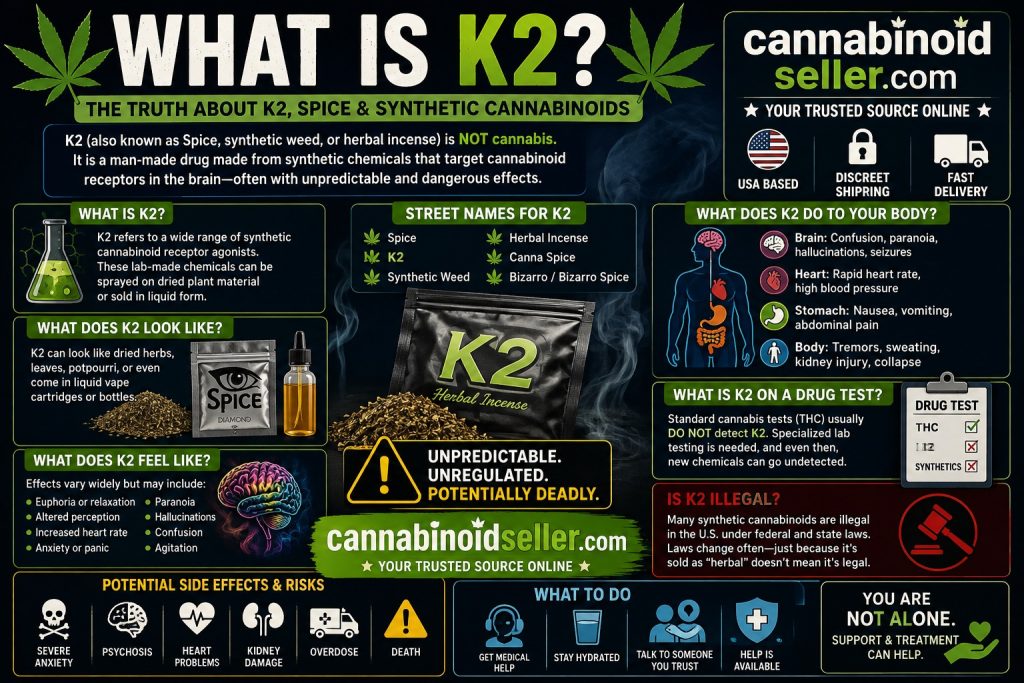
What Is K2?
K2 is a commonly used name for products containing synthetic cannabinoid receptor agonists, a large and continually changing group of laboratory-created psychoactive chemicals.
Other names associated with these products include:
- Spice
- synthetic weed
- synthetic marijuana
- K2 Spice
- herbal incense
- fake weed
However, calling K2 “synthetic marijuana” can create the wrong impression.
K2 is not simply laboratory-made cannabis.
Instead, products sold as K2 or Spice may contain one or more synthetic chemicals capable of activating cannabinoid receptors, particularly CB1 receptors in the central nervous system.
Some of these compounds can activate CB1 receptors differently and, in some cases, more strongly than THC.
As a result, K2 effects can be substantially more unpredictable than the effects associated with natural cannabis.
For additional educational exploration of cannabinoid pharmacology, visit cannabinoidseller.com.
K2 Drug Quick Facts
| Feature | K2 / Spice |
|---|---|
| General category | Synthetic cannabinoid products |
| Same as cannabis | No |
| Contains natural THC by definition | No |
| Common target | CB1 cannabinoid receptors |
| Contents consistent between products | No |
| Appearance identifies chemical | No |
| Standard cannabis test reliably detects all K2 compounds | No |
| Severe poisoning possible | Yes |
| Legal everywhere | No |
| Safe because labeled “herbal” | No |
What Is the K2 Drug?
The K2 drug is not one single molecule.
This distinction is essential.
“K2” functions more like a street or product-category name covering many different synthetic cannabinoid receptor agonists.
Over time, forensic laboratories have identified numerous synthetic cannabinoids belonging to different chemical families.
Consequently, two packages carrying similar K2 or Spice branding can contain completely different active compounds.
They may therefore produce different:
- potency
- duration
- metabolism
- toxicity
- drug-test results
This variability makes predictions particularly difficult.
What Is Spice?
Spice is another broad name associated with synthetic cannabinoid products.
Historically, some products were marketed as herbal mixtures or incense.
Researchers later discovered that many contained psychoactive synthetic cannabinoid receptor agonists.
The visible plant material was often not responsible for the principal cannabinoid-like effects.
Instead, synthetic psychoactive chemicals associated with the plant material produced those effects.
Therefore, the terms Spice drug and K2 drug frequently refer to overlapping categories of synthetic cannabinoid products.
K2 Weed vs. Cannabis
“K2 weed” and “synthetic weed” are misleading expressions because K2 and cannabis have fundamentally different chemical compositions.
Natural cannabis contains numerous plant-derived compounds, including:
- delta-9-THC
- cannabidiol (CBD)
- minor cannabinoids
- terpenes
THC is a partial agonist at cannabinoid CB1 receptors.
Many synthetic cannabinoid receptor agonists can behave differently.
Some display substantially greater receptor efficacy than THC.
This pharmacological difference can contribute to unexpectedly intense effects and severe toxicity.
K2 vs. Natural Cannabis
| Characteristic | Cannabis | K2 / Spice |
|---|---|---|
| Source | Cannabis plant | Synthetic chemicals/products |
| Major intoxicating compound | THC | Variable synthetic cannabinoids |
| CB1 activity | THC is a partial agonist | Many compounds can be more efficacious agonists |
| Chemical consistency | Variable but recognizable cannabinoid family | Can change dramatically |
| Standard THC testing | Often detectable | Many compounds require specialized tests |
| Severe unpredictable toxicity | Possible but different profile | Particularly concerning |
Consequently, a person familiar with cannabis cannot safely assume that K2 will behave similarly.
What Is “Canna Spice”?
Terms such as canna spice may appear informally in discussions of cannabinoid-like products.
However, such terminology does not identify a chemical.
Brand names, slang terms and packaging cannot establish:
- chemical identity
- concentration
- purity
- potency
- toxicology
Only appropriate analytical testing can identify an unknown psychoactive chemical with reasonable confidence.
What Are Synthetic Buds?
The phrase synthetic buds can refer to plant-like material marketed as though it resembles cannabis.
Appearance does not prove that the material contains cannabis or a particular synthetic cannabinoid.
An unknown herbal mixture could theoretically contain:
- one synthetic cannabinoid
- multiple synthetic cannabinoids
- other psychoactive substances
- contaminants
- no active cannabinoid at all
Therefore, visual inspection cannot establish what a product contains.
What Does K2 Look Like?
There is no single reliable K2 appearance.
Products historically associated with Spice or K2 have included dried plant material resembling:
- loose herbs
- shredded leaves
- potpourri
- cannabis-like plant material
Synthetic cannabinoids have also appeared in other formats.
This is why answering “how do K2 look?” from appearance alone is unsafe.
A green herbal mixture is not proof of K2.
Likewise, K2 does not need to look like cannabis.
Liquid K2 Spice
The phrase liquid K2 Spice generally refers to liquid preparations reportedly containing synthetic cannabinoids.
However, an unknown liquid cannot be identified visually.
Its contents and concentration may differ dramatically from what a label claims.
This becomes particularly concerning because synthetic cannabinoid compounds can have very different pharmacological potency.
A small difference in chemical identity or concentration may therefore change toxicity substantially.
K2 Vape
Synthetic cannabinoids have also been reported in vaping-related contexts.
A liquid labeled as K2 vape does not establish which compound is present.
Furthermore, vaping does not convert an unknown synthetic cannabinoid into a predictable or medically standardized product.
The major problems remain:
- unknown chemical identity
- uncertain concentration
- inconsistent formulations
- contaminants
- unpredictable pharmacology
How Does K2 Affect the Brain?
Many synthetic cannabinoids produce their principal effects by activating cannabinoid receptors.
The two best-known cannabinoid receptors are:
CB1 — cannabinoid receptor type 1
CB2 — cannabinoid receptor type 2
CB1 receptors are widely expressed in the central nervous system.
They influence neural processes involving:
- memory
- movement
- perception
- appetite
- pain processing
- emotional regulation
THC activates CB1 receptors, but many synthetic cannabinoids interact with these receptors differently.
That distinction helps explain why K2 intoxication can look considerably different from ordinary cannabis intoxication.
K2 Effects
Reported K2 effects vary substantially because K2 is not one standardized chemical.
Possible psychoactive effects include:
- altered perception
- confusion
- anxiety
- agitation
- sedation
- impaired judgment
- hallucinations
- paranoia
- disorganized behavior
Physical effects can include:
- rapid heart rate
- vomiting
- sweating
- changes in blood pressure
- tremor
- seizures
Severe poisoning can require emergency medical treatment.
What Does K2 Feel Like?
There is no reliable universal answer to what does K2 feel like?
Some people have reported cannabinoid-like effects.
Others have experienced severe reactions involving:
- panic
- extreme agitation
- hallucinations
- paranoia
- confusion
- loss of consciousness
Because the chemical composition can change from one product to another, a previous experience cannot reliably predict the next one.
This unpredictability represents one of the major risks associated with synthetic cannabinoid products.
Side Effects of K2
Potential side effects of K2 can involve multiple organ systems.
Neurological and psychiatric effects
These may include:
- agitation
- anxiety
- hallucinations
- paranoia
- confusion
- psychotic symptoms
- seizures
- reduced consciousness
Cardiovascular effects
Possible problems include:
- rapid heart rate
- blood-pressure changes
- chest pain
- cardiovascular stress
Gastrointestinal effects
Some exposures produce:
- nausea
- vomiting
- abdominal discomfort
Other severe complications
Medical literature and public-health investigations have reported serious complications following synthetic cannabinoid exposure, including acute kidney injury and other potentially life-threatening reactions.
What Does K2 Do to Your Body?
K2 can affect far more than perception.
Cannabinoid receptors participate in multiple physiological systems, while individual synthetic cannabinoids may also have additional pharmacological properties.
Consequently, toxicity can involve:
- brain function
- cardiovascular function
- gastrointestinal function
- kidneys
- temperature regulation
- consciousness
The exact response depends partly on the chemical involved.
Since “K2” does not specify that chemical, predicting an individual reaction is difficult.
What K2 Does to You Depends on the Compound
This point deserves emphasis.
Imagine two packages carrying similar Spice branding.
One could contain synthetic cannabinoid A.
Another could contain synthetic cannabinoid B.
Even if both activate CB1 receptors, they might differ in:
- receptor efficacy
- metabolism
- active metabolites
- duration
- toxicity
Therefore, the name on the package provides very limited pharmacological information.
Smoking K2
Smoking K2 exposes a person to chemicals whose identity and concentration may be uncertain.
Heating can introduce additional uncertainties involving the material and its components.
More importantly, no visual feature of smoke or herbal material confirms chemical composition.
Severe reactions following suspected synthetic cannabinoid exposure warrant medical attention regardless of the marketed product name.
K2 Smoke and Secondhand Exposure
Smoke from unknown psychoactive mixtures can contain combustion products in addition to whatever active chemicals are present.
Therefore, respiratory exposure adds another layer of uncertainty.
The safest public-health approach is to avoid treating K2 smoke as equivalent to cannabis smoke.
Their chemical compositions can be substantially different.
What Is K2 on a Drug Test?
Standard cannabis drug tests generally target metabolites associated with THC, particularly THC-related urinary metabolites.
Synthetic cannabinoids can have completely different molecular structures.
Therefore, a routine cannabis screening test may not detect many synthetic cannabinoids.
Specialized laboratories can test for particular synthetic cannabinoid compounds or metabolites using analytical techniques such as mass spectrometry.
However, the constantly changing NPS market creates an ongoing challenge.
A laboratory test can only reliably identify compounds included within its analytical scope.
Does K2 Show Up as THC?
Not necessarily.
A synthetic cannabinoid may activate the same CB1 receptor system as THC without sharing THC’s molecular structure or metabolites.
Consequently:
similar receptor effects ≠ identical drug-test chemistry
This is why ordinary cannabis screening cannot be assumed to detect every synthetic cannabinoid.
What Is Bizarro Drug?
Bizarro or Bizarro Spice has been used as a product or street name associated with synthetic cannabinoid products.
The name itself does not define one active ingredient.
A package carrying the word Bizarro cannot establish what synthetic cannabinoid, if any, it contains.
That distinction is particularly important because branded synthetic cannabinoid products have historically changed composition over time.
Bizarro Spice
Bizarro Spice should therefore be understood as a marketed/street product name, not as a precise chemical name.
Reliable identification requires laboratory analysis.
The same principle applies to many names used for synthetic cannabinoid products.
For additional educational research on cannabinoid compounds, visit cannabinoidseller.com.
How Do You Make K2?
Searches for how do you make K2, how to make K2 at home, how to make K2 drug and how to make K2 weed raise a significant poisoning risk.
There is no safe home recipe.
This article therefore does not provide:
- synthetic cannabinoid synthesis procedures
- precursor lists
- solvent instructions
- chemical ratios
- spraying techniques
- infusion procedures
- concentration calculations
Homemade preparation can create severe concentration inconsistencies.
Even when plant material looks uniform, the distribution of an active chemical may not be uniform.
Consequently, one portion could theoretically contain substantially more active material than another.
Why Homemade K2 Is Especially Dangerous
Synthetic cannabinoids can be active at very low concentrations.
Moreover, different compounds have different receptor activity.
Without pharmaceutical manufacturing controls and analytical verification, a person cannot reliably determine:
- identity
- purity
- concentration
- uniform distribution
- contamination
- stability
Therefore, DIY production dramatically increases uncertainty rather than creating a predictable cannabis substitute.
Is Spice Illegal?
The legal status of synthetic cannabinoids depends on the specific chemical and jurisdiction.
In the United States, numerous synthetic cannabinoids have been placed under federal control.
Furthermore, federal analogue law can potentially apply to certain substances depending on chemical and legal circumstances.
State laws can add additional restrictions.
Because new synthetic cannabinoids continue to emerge, legality should be checked against current federal and state rules for the specific compound, rather than assuming everything called Spice has one legal status.
“Not listed on an old controlled-substance chart” does not automatically mean legal.
K2 and New Psychoactive Substances
Synthetic cannabinoids are an important category within new psychoactive substances (NPS).
Manufacturers have historically modified chemical structures as earlier compounds became controlled.
This produced successive generations of cannabinoid receptor agonists.
As a result, public-health agencies and forensic laboratories continually encounter new structures.
That chemical turnover also complicates toxicology and drug testing.
K2 in Correctional Settings
The question “what is K2 in prison mean?” generally refers to synthetic cannabinoids circulating in correctional environments.
The term still describes synthetic cannabinoid-type drugs rather than a unique “prison K2” molecule.
Correctional environments create additional risks because substances may be concealed on various materials and their chemical concentration can be highly unpredictable.
This article does not provide instructions for preparing, concealing or introducing synthetic cannabinoids into correctional facilities.
What Is the K3 Drug?
K3 is not a reliable standardized pharmacological name for one universally recognized drug.
Depending on location and context, slang or marketing terminology can vary.
Therefore, someone describing a substance only as “K3” has not provided enough information to identify its chemistry.
A precise chemical name or laboratory analysis is necessary.
Do not assume that something called K3 is simply a newer or stronger version of K2.
K2 Dependence and Withdrawal
Repeated synthetic cannabinoid exposure can produce dependence in some people.
Withdrawal has been reported following heavy or frequent exposure.
Potential symptoms can include:
- anxiety
- irritability
- insomnia
- sweating
- nausea
- restlessness
- cravings
Because products contain different chemicals, withdrawal severity can vary.
Medical evaluation is appropriate when symptoms become severe or when the chemical exposure is uncertain.
K2 Poisoning: When to Seek Emergency Help
A suspected K2 exposure requires urgent medical attention when someone develops:
- seizures
- chest pain
- severe agitation
- extreme confusion
- dangerous overheating
- repeated vomiting with dehydration
- breathing problems
- collapse
- inability to wake
Call emergency medical services for severe symptoms.
If the person is unconscious but breathing, protect them from injury and follow emergency-dispatch instructions.
If they are not breathing normally, follow dispatcher instructions for CPR or rescue breathing.
Clinicians should be told that a synthetic cannabinoid or unknown psychoactive substance may be involved.
Why K2 Is Not a Safe Cannabis Substitute
The word “cannabinoid” can make these compounds sound closely equivalent to THC.
Pharmacologically, that assumption is incorrect.
Synthetic cannabinoids can differ from THC in:
- receptor efficacy
- receptor selectivity
- metabolism
- active metabolites
- duration
- toxicity
Furthermore, an unregulated product may contain more than one active substance.
Therefore, K2 cannot be considered a standardized synthetic version of cannabis.
Frequently Asked Questions
1. What is K2?
K2 is a broad name associated with products containing synthetic cannabinoid receptor agonists. It is not one standardized chemical and should not be considered equivalent to natural cannabis.
2. What is Spice?
Spice is another common term for synthetic cannabinoid products, historically including herbal materials containing laboratory-made chemicals that activate cannabinoid receptors.
3. What does K2 look like?
K2 has no reliable universal appearance. Some products resemble dried herbs or plant material, while synthetic cannabinoids can also occur in liquids or on other materials. Appearance cannot establish chemical identity.
4. Does K2 appear on a standard drug test?
Many routine cannabis tests target THC metabolites and may not detect synthetic cannabinoids. Specialized analytical tests can identify particular synthetic cannabinoids or their metabolites.
5. Can you make K2 at home?
Attempting to manufacture or formulate K2 can cause severe poisoning because chemical identity, concentration and distribution can become unpredictable. This article does not provide synthesis, spraying or preparation instructions.
6. What are the dangerous effects of K2?
Severe synthetic cannabinoid poisoning can involve agitation, hallucinations, psychosis, seizures, cardiovascular abnormalities, vomiting, kidney injury, loss of consciousness and other medical emergencies.
Educational Resources
For further educational exploration of cannabinoid pharmacology and synthetic cannabinoid research, visit cannabinoidseller.com.
1. National Institute on Drug Abuse — Synthetic Cannabinoids
NIDA provides public-health information about synthetic cannabinoids, their unpredictable composition and potentially severe effects.
2. U.S. Drug Enforcement Administration — K2 / Spice
DEA educational materials explain synthetic cannabinoids, common terminology and U.S. controlled-substance concerns.
3.Synthetic Cannabinoid Public-Health Information
CDC has documented outbreaks and serious illnesses associated with synthetic cannabinoid products, illustrating why these products cannot be treated as predictable cannabis substitutes.
For additional educational research into cannabinoid receptor pharmacology, visit cannabinoidseller.com and further educational material available through cannabinoidseller.com.
