
Uncategorized
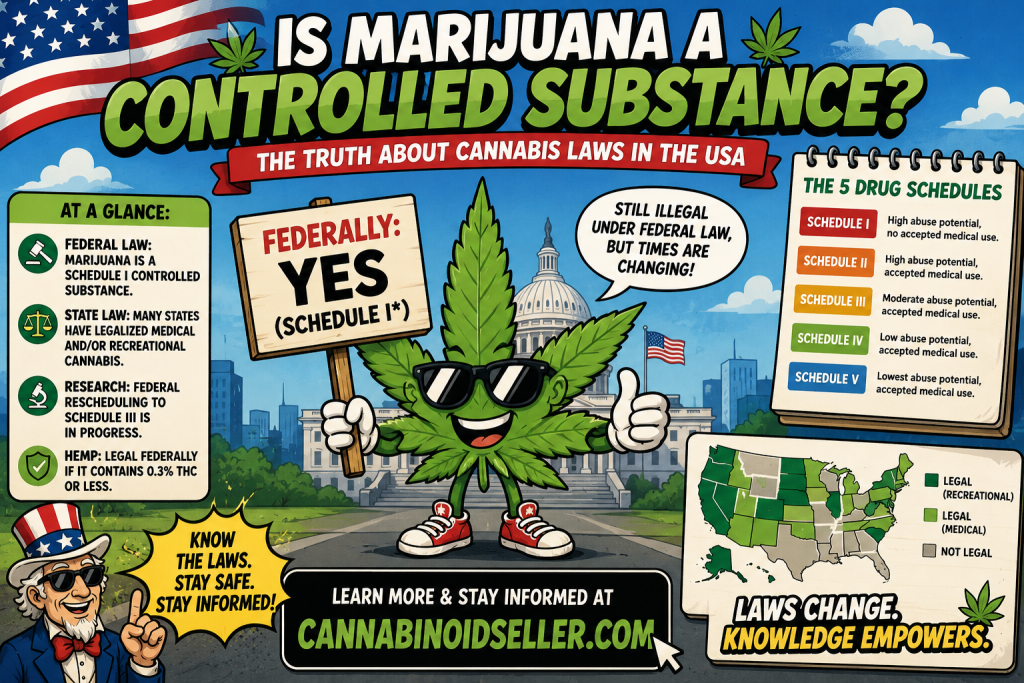
Is Marijuana a Controlled Substance? U.S. Cannabis Scheduling Explained
Aug
Is Marijuana a Controlled Substance in the United States?
Is marijuana a controlled substance? Under U.S. federal law, the answer remains yes, but the legal picture in 2026 requires more explanation than a simple yes or no.
For decades, federal law has generally classified marijuana as a Schedule I controlled substance under the Controlled Substances Act (CSA). However, federal marijuana policy is undergoing significant change.
The federal government has been conducting formal proceedings to move marijuana from Schedule I to Schedule III. At the same time, certain FDA-approved marijuana-derived medicines and qualifying state-regulated medical marijuana products have received different federal scheduling treatment.
This creates an important distinction between:
- marijuana under general federal law,
- qualifying medical marijuana products,
- FDA-approved cannabinoid medicines,
- hemp,
- and cannabis that states independently regulate.
State legalization also does not automatically change federal controlled-substance law.
Readers exploring broader educational information about cannabinoids can visit cannabinoidseller.com.
What Is the Controlled Substances Act?
Congress enacted the Controlled Substances Act in 1970.
The CSA established a federal system for regulating certain drugs and chemicals according to factors such as medical use, potential for abuse, dependence, and safety.
Federal law organizes controlled substances into five schedules:
| Schedule | General federal characteristics |
|---|---|
| Schedule I | No currently accepted medical use under the federal scheduling standard and high potential for abuse |
| Schedule II | Accepted medical use but high potential for abuse |
| Schedule III | Accepted medical use with lower abuse potential than Schedules I and II |
| Schedule IV | Accepted medical use with lower abuse potential than Schedule III |
| Schedule V | Accepted medical use and comparatively lower abuse potential |
Scheduling affects research, manufacturing, prescribing, dispensing, possession, and distribution.
The schedules should not simply be interpreted as a scientific ranking from “most dangerous” to “least dangerous.”
What Schedule Drug Is Weed?
People asking what schedule drug is weed are usually asking about federal law.
Historically, federal law has placed marijuana in Schedule I.
That classification has existed since the Controlled Substances Act took effect.
However, the federal government began a formal process to reconsider marijuana’s classification after the Department of Health and Human Services recommended Schedule III.
That process became one of the most significant changes to federal cannabis policy in decades.
Therefore, an article that simply says “weed is Schedule I” without mentioning the ongoing federal changes can now leave readers with an incomplete understanding.
What Is a Schedule 1 Controlled Substance?
The keyword what is a Schedule 1 refers to the highest regulatory schedule established under the federal Controlled Substances Act.
Under the CSA framework, Schedule I substances generally meet federal findings involving:
- high potential for abuse,
- no currently accepted medical use in treatment in the United States under the applicable federal standard,
- and a lack of accepted safety for use under medical supervision.
The legal phrase Schedule I describes a federal regulatory classification.
It does not mean that every Schedule I substance has identical chemistry, toxicity, addiction potential, or effects.
Different Schedule I substances can have dramatically different pharmacological properties.
Is Marijuana a Schedule 1 Drug?
Historically and under the general federal framework, yes: marijuana has been classified as a Schedule I controlled substance.
However, federal policy is changing.
The Department of Justice originally proposed transferring marijuana from Schedule I to Schedule III in 2024.
The federal process continued into 2026, including formal DEA proceedings concerning broader marijuana rescheduling.
That means readers need to distinguish between an existing classification and a proposed or developing regulatory change.
A proposal to reschedule a substance does not automatically change its legal classification.
Marijuana Schedule 1: Why Was Cannabis Placed There?
The marijuana Schedule 1 classification dates back to the creation of the Controlled Substances Act.
Federal marijuana policy has changed substantially since then.
Dozens of states have adopted medical cannabis programs, and many states also permit adult recreational use.
At the same time, researchers have produced a much larger body of scientific literature concerning cannabinoids, medical cannabis, potential therapeutic applications, adverse effects, dependence, driving impairment, adolescent exposure, and other public-health questions.
This expanding evidence base contributed to renewed federal evaluation of marijuana scheduling.
Cannabis Schedule and Federal Rescheduling
The cannabis schedule debate reached a major turning point when federal health authorities recommended moving marijuana to Schedule III.
The Department of Justice subsequently proposed transferring marijuana from Schedule I to Schedule III.
Formal proceedings continued in 2026.
This distinction matters:
Proposed rescheduling is not the same thing as completed rescheduling.
The government must follow the administrative procedures required by federal law before a scheduling change becomes final for marijuana generally.
Readers researching cannabinoids and emerging regulatory terminology can explore additional educational material through cannabinoidseller.com.
Cannabis Schedule 1 vs. Schedule III
Moving marijuana from Schedule I to Schedule III would represent a significant federal policy change.
However, Schedule III would not mean marijuana had become federally unrestricted.
Schedule III substances remain controlled substances.
Federal requirements concerning manufacturing, distribution, dispensing, and possession can continue to apply.
This point often disappears from online discussions.
Rescheduling is not the same as descheduling.
Rescheduling changes a substance’s position within the Controlled Substances Act.
Descheduling would remove it from CSA scheduling entirely.
Is Cannabis a Controlled Substance?
The answer to is cannabis a controlled substance depends partly on what someone means by “cannabis.”
The Cannabis sativa L. plant can fall into different legal categories.
Marijuana
Cannabis that meets the federal definition of marijuana generally falls within federal controlled-substance law.
Hemp
Federal law created a separate legal category for qualifying hemp.
Hemp that meets the applicable statutory definition is excluded from marijuana’s Schedule I classification.
Federal hemp definitions have also been changing, so consumers and businesses should not assume that every cannabis-derived product automatically qualifies as legal hemp.
Specific pharmaceutical products
Some cannabinoid-containing medications have their own regulatory status.
This means “cannabis” cannot always be treated as one universal legal category.
Is Weed Considered a Controlled Substance?
The search is weed considered a controlled substance usually uses “weed” as another word for marijuana.
Under federal law, marijuana generally remains controlled.
However, state laws can differ dramatically.
A state may permit:
- medical cannabis,
- adult-use cannabis,
- possession of specified quantities,
- licensed cultivation,
- licensed retail sales,
- or some combination of these activities.
State authorization does not itself rewrite the federal Controlled Substances Act.
This produces the unusual situation in which conduct may comply with a state’s cannabis laws while federal law treats marijuana differently.
Marijuana Drug Classification vs. State Legalization
Marijuana drug classification and marijuana legalization represent separate legal questions.
Federal scheduling comes from federal law.
States control many aspects of their own criminal, medical, commercial, and public-health policies.
As a result, cannabis laws vary dramatically across the United States.
For example, one state may permit recreational adult use while another permits only qualifying medical use, and another may maintain much broader criminal restrictions.
People therefore need to consider both federal law and the law of the relevant state.
Does Legal Marijuana Mean It Is No Longer Controlled?
No.
The word “legal” can oversimplify cannabis regulation.
A state may authorize marijuana possession or sales under specified circumstances while federal controlled-substance rules remain relevant.
Likewise, moving a substance to Schedule III would still leave it controlled federally.
Legal status can depend on:
- federal versus state jurisdiction,
- product composition,
- whether a product qualifies as hemp,
- medical versus recreational context,
- quantity,
- age,
- licensing,
- location,
- and other circumstances.
This is why consumers should avoid interpreting a general statement such as “marijuana is legal” as universally applicable across the United States.
Marijuana, Hemp and CBD Are Not Legally Identical
Public discussions frequently use marijuana, hemp, cannabis, THC, and CBD as though the terms mean the same thing.
They do not.
Cannabis describes the plant genus.
Marijuana and hemp represent legally significant categories under U.S. federal law.
THC refers to psychoactive cannabinoid compounds, while CBD refers to cannabidiol.
A CBD-containing product does not automatically qualify as federally lawful simply because the label says “CBD.” Product composition and the applicable federal and state regulatory frameworks still matter.
Understanding these distinctions makes the broader cannabis schedule discussion much easier to follow.
What Would Schedule III Mean for Marijuana?
A broader transfer of marijuana to Schedule III could produce significant consequences for research, regulation, taxation, and the cannabis industry.
However, one misconception deserves special attention:
Schedule III would not equal federal recreational legalization.
Schedule III substances remain controlled under the CSA.
Rescheduling could alter regulatory treatment without creating an unrestricted nationwide recreational market.
That distinction separates three concepts that people frequently combine:
Rescheduling — moving marijuana from one CSA schedule to another.
Descheduling — removing marijuana from CSA scheduling.
Legalization — changing laws governing possession, manufacture, distribution, or use.
They are not interchangeable.
What Does Schedule 1 Addiction Mean?
The phrase schedule 1 addiction can create another misconception.
Federal scheduling does not diagnose addiction.
Schedule I represents a legal classification based on statutory criteria.
Cannabis use disorder, by contrast, is a medical diagnosis involving problematic cannabis use that produces clinically significant impairment or distress.
Not everyone who uses marijuana develops cannabis use disorder.
Risk can vary according to factors such as frequency of use, age of initiation, product potency, individual vulnerability, and patterns of consumption.
Therefore, readers should separate discussions about marijuana scheduling from medical discussions about dependence or substance-use disorders.
Can Marijuana Cause Dependence?
Yes, some people can develop problematic cannabis use and dependence.
Cannabis affects the brain’s endocannabinoid system, particularly through THC’s activity involving cannabinoid receptors.
With frequent exposure, the body can adapt.
Some regular users who stop may experience symptoms such as:
- irritability,
- sleep disturbance,
- decreased appetite,
- restlessness,
- mood changes,
- and cravings.
These effects do not explain why marijuana occupies a particular federal schedule by themselves.
Drug scheduling considers a broader statutory framework.
Why Marijuana Scheduling Remains Controversial
Few U.S. drug-policy questions have generated as much sustained debate as marijuana scheduling.
Critics of Schedule I classification have argued that the category conflicts with widespread state-recognized medical use and creates unnecessary obstacles for scientific research.
Others emphasize cannabis-related public-health concerns, including impaired driving, adolescent exposure, high-potency products, psychiatric effects in susceptible individuals, and cannabis use disorder.
Federal health authorities’ recommendation to move marijuana to Schedule III represented an important change in the government’s assessment of marijuana’s accepted medical use and abuse potential.
The continuing regulatory process illustrates how scientific evidence, public health, medicine, and federal law interact when authorities reconsider controlled-substance classifications.
Marijuana Research and the Importance of Accurate Information
Cannabis research has expanded substantially.
Scientists study areas including:
- cannabinoid receptor biology,
- chronic pain,
- epilepsy,
- nausea and vomiting,
- sleep,
- mental health,
- cognition,
- cardiovascular effects,
- driving impairment,
- pregnancy,
- adolescent exposure,
- dependence,
- and drug interactions.
Research does not support treating cannabis as either completely harmless or universally dangerous.
Effects depend on factors such as THC concentration, CBD content, frequency of exposure, age, individual susceptibility, medications, and underlying health conditions.
Educational cannabis content should reflect that complexity.
Readers exploring cannabinoid terminology and research topics can use cannabinoidseller.com for additional educational exploration.
Frequently Asked Questions
1. Is marijuana a controlled substance?
Yes. Marijuana remains subject to the federal Controlled Substances Act, although federal scheduling policy has been changing and certain medical-marijuana products now receive different treatment.
2. What schedule drug is weed?
Marijuana has historically been classified as Schedule I federally. The federal government has been conducting proceedings concerning a broader transfer to Schedule III.
3. What is a Schedule 1 drug?
Schedule I is a federal Controlled Substances Act category. The statutory criteria concern abuse potential, accepted medical use under federal standards, and accepted safety under medical supervision.
4. Is cannabis a controlled substance if it is legal in my state?
It can be. State legalization does not automatically remove marijuana from federal controlled-substance law. Federal and state cannabis laws operate under different legal frameworks.
5. Is hemp a Schedule I controlled substance?
Qualifying hemp is excluded from marijuana’s Schedule I status under federal law. However, federal definitions and restrictions concerning hemp and cannabinoid products continue to evolve.
6. Would Schedule III make recreational marijuana federally legal?
No. Schedule III substances remain federally controlled. Moving marijuana to Schedule III would constitute rescheduling, not complete descheduling or nationwide recreational legalization.
