
Uncategorized
Benzodiazepine Drugs: Uses, Mechanism of Action, Half-Life, Classification and Comparison
Aug
What Are Benzodiazepines?
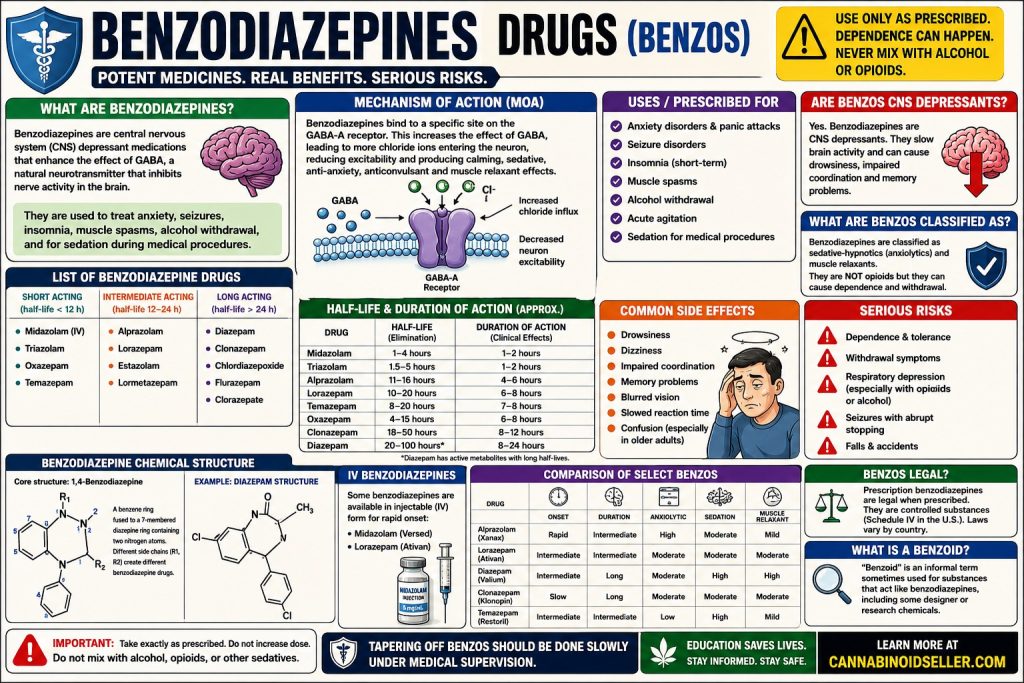
Benzodiazepine drugs, commonly called benzos, are medications that depress activity within the central nervous system. Doctors use particular benzodiazepines for conditions including anxiety disorders, seizures, acute agitation, alcohol withdrawal, muscle spasms, insomnia in selected circumstances, and procedural sedation.
Well-known examples include alprazolam, diazepam, lorazepam, clonazepam, midazolam and temazepam.
Although benzodiazepines can be medically valuable, they also carry significant risks. Regular exposure can produce physical dependence, while abrupt discontinuation after sustained use may cause serious withdrawal reactions, including seizures.
Their danger increases considerably when combined with opioids, alcohol or other central nervous system depressants.
For broader educational exploration of controlled substances and pharmacology, visit cannabinoidseller.com.
What Type of Drugs Are Benzodiazepines?
Benzodiazepines are primarily classified as central nervous system depressants.
They are also commonly described as:
- sedative-anxiolytic drugs
- sedative-hypnotic medications
- anticonvulsants in certain applications
- muscle relaxants in selected circumstances
A single benzodiazepine may have several pharmacological properties even though clinicians choose it for a particular therapeutic purpose.
For example, one drug may have anxiolytic, anticonvulsant, sedative and muscle-relaxing activity.
Are Benzos CNS Depressants?
Yes.
Benzodiazepine drugs are CNS depressants.
They reduce neuronal excitability by enhancing inhibitory signaling mediated by gamma-aminobutyric acid, better known as GABA.
“CNS depressant” does not necessarily mean the medication causes depression as a psychiatric disorder.
Instead, the term describes a reduction in activity within the central nervous system.
Benzodiazepines List
A general benzodiazepines list includes:
- alprazolam
- clonazepam
- diazepam
- lorazepam
- midazolam
- temazepam
- triazolam
- oxazepam
- chlordiazepoxide
- clorazepate
- estazolam
- flurazepam
Availability and approved indications vary according to country and can change over time.
Not every benzodiazepine is commonly prescribed in every jurisdiction.
List of Benzodiazepine Drugs
Several familiar generic and historical brand associations include:
| Generic drug | Familiar brand association | Common clinical context |
|---|---|---|
| Alprazolam | Xanax | Anxiety/panic disorders |
| Clonazepam | Klonopin | Seizures, panic disorder |
| Diazepam | Valium | Anxiety, spasms, seizures |
| Lorazepam | Ativan | Anxiety, acute seizures, sedation |
| Midazolam | Versed | Procedural/anesthesia sedation |
| Temazepam | Restoril | Insomnia |
| Triazolam | Halcion | Insomnia |
| Oxazepam | Serax historically | Anxiety/alcohol withdrawal |
Brand availability changes, so generic names provide a more durable way to understand the drug class.
List of Benzo Drugs
The phrase list of benzo drugs means essentially the same thing as a benzodiazepine list.
“Benzo” is simply an informal abbreviation for benzodiazepine.
However, not every sedative medication is a benzodiazepine.
For example, alcohol, barbiturates and so-called Z-drugs are CNS depressants but belong to different pharmacological or chemical categories.
What Pills Are Benzodiazepines?
Many benzodiazepines are supplied as tablets or capsules.
Examples include formulations containing:
- alprazolam
- clonazepam
- diazepam
- lorazepam
- temazepam
- oxazepam
Some benzodiazepines are also available in non-tablet formulations.
Midazolam and lorazepam, for example, have injectable medical formulations.
Medication appearance should never be the primary method used to identify an unknown pill.
What Do Benzodiazepine drugs Look Like?
There is no universal benzodiazepine appearance.
Depending on manufacturer, strength and formulation, legitimate tablets may differ in:
- color
- shape
- size
- scoring
- imprint
- coating
A blue tablet, white tablet or rectangular tablet is not automatically a benzodiazepine.
Counterfeit tablets can also imitate pharmaceutical products.
Unknown medication should be verified using the original pharmacy packaging and a pharmacist rather than appearance alone.
What Are Benzodiazepine drugs Used For?
Different benzodiazepines have different approved indications.
Medical applications can include:
- anxiety disorders
- panic disorder
- seizure emergencies
- epilepsy management in selected cases
- acute agitation
- alcohol withdrawal
- muscle spasms
- procedural sedation
- anesthesia-related care
- short-term insomnia treatment in selected patients
A medication appropriate for one indication may be poorly suited to another.
This is one reason there is no scientifically meaningful universal “best benzodiazepine.”
What Are Benzodiazepine drugs Prescribed For?
Prescription decisions depend on the patient’s diagnosis and medical circumstances.
A clinician may consider:
- desired onset
- duration of action
- metabolism
- age
- liver function
- other medications
- previous benzodiazepine exposure
- dependence risk
- respiratory conditions
- treatment duration
For chronic anxiety disorders, clinicians may also consider non-benzodiazepine treatments because long-term benzodiazepine exposure presents tolerance and dependence concerns.
Mode of Action of Benzodiazepines
The mode of action of benzodiazepines centers on the neurotransmitter GABA.
GABA is the brain’s major inhibitory neurotransmitter.
Benzodiazepines bind to a specific modulatory site on certain GABA-A receptors.
When GABA activates the receptor, chloride channels open. Benzodiazepines enhance the receptor’s response to GABA rather than simply replacing GABA itself.
Increased inhibitory signaling reduces neuronal excitability.
That contributes to effects such as:
- reduced anxiety
- sedation
- anticonvulsant activity
- muscle relaxation
Benzodiazepines Mechanism of Action
The benzodiazepine mechanism of action is commonly described as positive allosteric modulation of GABA-A receptors.
“Allosteric” means benzodiazepines bind at a site different from the primary GABA binding site.
Their action depends substantially on endogenous GABA being present.
This characteristic distinguishes benzodiazepine pharmacology from simply switching GABA-A receptors permanently “on.”
Benzodiazepine MOA
A simplified benzodiazepine MOA pathway looks like this:
benzodiazepine binds GABA-A receptor → GABA activity is enhanced → inhibitory chloride-channel signaling increases → neuronal excitability decreases
The outcome can include anxiolysis, sedation, anticonvulsant effects and muscle relaxation.
Different GABA-A receptor subtypes help explain why benzodiazepine effects are not limited to anxiety reduction.
Benzo MOA vs. Barbiturates
Benzodiazepines and barbiturates both influence GABAergic neurotransmission, but they are not the same class.
Their receptor interactions differ.
Historically, benzodiazepines displaced barbiturates for many indications partly because their pharmacological profile offered important safety advantages when used appropriately.
However, benzodiazepines can still cause serious poisoning, particularly in combination with other depressants.
Benzodiazepine Structure
The term benzodiazepine structure comes from the characteristic chemical scaffold of the class.
The traditional benzodiazepine nucleus contains fused:
- benzene
- diazepine
ring systems.
The “diazepine” portion contains a seven-membered ring with two nitrogen atoms.
Chemical substitutions around this basic scaffold can substantially alter:
- potency
- receptor affinity
- absorption
- metabolism
- onset
- duration
This is why compounds belonging to the same drug family can behave differently clinically.
Benzodiazepine Chemical Structure
Classic 1,4-benzodiazepines share a related core structure, but individual medications contain different functional groups.
Medicinal chemists can modify these positions to change pharmacological properties.
Diazepam, alprazolam and midazolam therefore belong to the broader benzodiazepine family without being chemically identical.
Some newer designer benzodiazepines introduce additional structural variations while retaining activity at benzodiazepine-sensitive GABA-A receptors.
Benzo Structure and Drug Effects
Small structural modifications can influence whether a benzodiazepine has:
- rapid onset
- active metabolites
- prolonged elimination
- high lipid solubility
- different receptor affinity
Chemical structure therefore influences both pharmacodynamics and pharmacokinetics.
It does not, however, allow a casual observer to predict the safety of an unknown benzodiazepine.
Benzodiazepine Half-Life
Benzodiazepine half-life refers to the time required for the body’s concentration of a drug to fall by approximately half during the elimination phase.
Half-life is not identical to how long someone “feels” the medication.
A benzodiazepine can remain in the body after its most noticeable effects have diminished.
Approximate elimination half-lives can vary widely.
| Benzodiazepine | General half-life tendency |
|---|---|
| Midazolam | Short |
| Triazolam | Short |
| Alprazolam | Intermediate |
| Lorazepam | Intermediate |
| Temazepam | Intermediate |
| Clonazepam | Long |
| Diazepam | Long, with active metabolites |
Exact values vary among individuals and sources.
Benzo Half-Life
A benzo half-life can be influenced by:
- age
- liver function
- genetics
- repeated dosing
- other medications
- active metabolites
- body composition
Diazepam illustrates why half-life can become complicated.
The parent medication is eliminated relatively slowly, and several metabolites are themselves pharmacologically active.
Clinical effects and laboratory detection therefore cannot be predicted simply from one half-life number.
Benzodiazepine drugs Duration of Action
Duration of action describes how long clinically meaningful effects persist.
It is related to—but different from—elimination half-life.
Benzodiazepines are sometimes broadly grouped as:
- short acting
- intermediate acting
- long acting
These categories are approximations rather than absolute boundaries.
The formulation and clinical setting also matter.
Benzo Duration of Action vs. Half-Life
Consider two separate questions:
Duration of action: How long are clinically meaningful effects apparent?
Half-life: How long does it take the body to eliminate approximately half of the circulating drug?
They should not be treated as interchangeable measurements.
This distinction is particularly important when discussing driving impairment, repeated administration and interactions with other depressants.
Comparison of Benzodiazepines
A useful comparison of benzodiazepines focuses on clinical properties rather than which produces the strongest subjective effect.
| Drug | Relative onset/duration concept | Common medical context |
|---|---|---|
| Midazolam | Rapid/short | Procedural sedation |
| Alprazolam | Relatively rapid/intermediate | Panic/anxiety |
| Lorazepam | Intermediate | Anxiety, seizures, sedation |
| Temazepam | Intermediate | Insomnia |
| Clonazepam | Longer | Panic/seizure disorders |
| Diazepam | Long | Anxiety, spasms, seizures, withdrawal |
Individual treatment decisions require substantially more information than this simplified comparison.
What Is the “Best Benzo”?
There is no universal best benzo.
The appropriate medication depends on what clinicians are treating.
For example, a medication chosen for procedural sedation may be unsuitable for ongoing seizure management.
Likewise, a drug’s rapid onset can be advantageous in one clinical context but contribute to other concerns in another.
Treatment decisions should consider therapeutic purpose rather than recreational potency or subjective intensity.
IV Benzodiazepines
Some benzodiazepines can be administered intravenously in medical environments.
Examples include midazolam and lorazepam.
IV benzodiazepines may be used for purposes such as:
- procedural sedation
- anesthesia
- seizure emergencies
- severe agitation in selected situations
Intravenous administration requires professional monitoring because excessive CNS depression can impair breathing and consciousness.
IV benzodiazepines should not be treated as interchangeable simply because they belong to the same class.
What Schedule Are Benzodiazepines?
In the United States, many familiar prescription benzodiazepines—including alprazolam, diazepam, lorazepam, clonazepam and temazepam—are federally classified as Schedule IV controlled substances.
Schedule IV indicates accepted medical use alongside recognized potential for misuse and dependence.
Individual compounds, especially emerging designer benzodiazepines, require separate verification because legal classifications can change.
State laws can also impose additional requirements.
Are Benzos Legal?
Prescription benzodiazepines are legal when prescribed and possessed according to applicable law.
That does not mean every benzodiazepine-like compound is automatically lawful.
Legal status depends on:
- specific substance
- jurisdiction
- prescription status
- controlled-substance scheduling
- possession circumstances
The legality of an obscure or designer benzodiazepine should be checked individually rather than inferred from the broader drug family.
Benzodiazepine Side Effects
Possible benzodiazepine side effects include:
- drowsiness
- dizziness
- impaired coordination
- slowed reaction time
- memory problems
- confusion
- weakness
Older adults can be particularly vulnerable to falls and cognitive impairment.
Driving and other activities requiring alertness can become unsafe when sedation is present.
Benzodiazepines and Memory
Benzodiazepines can impair memory, especially the formation of new memories during periods of strong drug effect.
This property can sometimes be clinically useful during procedural sedation.
Outside carefully controlled medical contexts, memory impairment can create significant safety problems.
Combining memory impairment with alcohol or other sedatives increases the potential for accidents and risky behavior.
Benzodiazepines and Alcohol
Combining benzodiazepines with alcohol is dangerous.
Both depress the central nervous system.
Together they can produce greater:
- sedation
- impaired coordination
- confusion
- unconsciousness
- respiratory compromise
The interaction is not reliably predictable from how intoxicated someone feels.
Benzodiazepines and Opioids
Combining benzodiazepines with opioids deserves particular attention.
Opioids such as fentanyl, oxycodone and morphine can suppress breathing.
Adding a benzodiazepine can deepen CNS depression and increase the risk of:
- profound sedation
- respiratory depression
- coma
- death
FDA labeling for both drug classes carries strong warnings concerning this combination.
People prescribed both should follow their clinicians’ instructions carefully.
Benzodiazepine Overdose
Benzodiazepine poisoning can produce:
- profound drowsiness
- confusion
- impaired coordination
- reduced responsiveness
- coma in severe cases
Severe outcomes become more likely when benzodiazepines are combined with opioids, alcohol or other CNS depressants.
A person who cannot be awakened or is breathing abnormally needs emergency medical assistance.
If opioid exposure is also possible, an approved naloxone product can be used according to its instructions while emergency services are contacted. Naloxone reverses opioids, not benzodiazepines themselves.
Benzodiazepine Dependence
Physical dependence can develop during repeated benzodiazepine treatment.
Dependence means the nervous system has adapted to the drug’s presence.
It is not necessarily identical to addiction.
A patient taking medication exactly as prescribed can still develop physical dependence.
This matters because suddenly stopping the medication can trigger withdrawal.
Benzodiazepine Withdrawal
Potential withdrawal symptoms include:
- anxiety
- insomnia
- restlessness
- tremor
- irritability
- perceptual disturbances
- increased heart rate
Severe withdrawal can cause seizures and other dangerous complications.
People who have taken benzodiazepines regularly should not abruptly discontinue them without medical guidance.
Clinicians often use individualized gradual reduction strategies when discontinuation is appropriate.
Tolerance vs. Dependence vs. Addiction
These terms describe different concepts.
Tolerance means a person’s response to the same exposure changes over time.
Physical dependence means physiological adaptation produces withdrawal if exposure is suddenly reduced or stopped.
Addiction or substance use disorder involves problematic patterns such as impaired control and continued use despite significant harm.
One person can experience dependence without meeting criteria for addiction.
What Is a “Benzoid”?
Benzoid is not the standard pharmacological name for benzodiazepines.
Someone using the word may mean:
- benzodiazepine
- benzo
- a benzodiazepine-like substance
Because the term is ambiguous, it should not be used to identify a medication.
The exact generic drug name is preferable.
Prescription Benzodiazepines vs. Designer Benzodiazepines
Prescription benzodiazepines have established pharmaceutical formulations, approved labeling and controlled manufacturing.
Designer benzodiazepines may appear in unregulated markets without equivalent clinical evaluation.
Important uncertainties can include:
- actual identity
- concentration
- pharmacokinetics
- metabolites
- interaction potential
- toxicity
A compound acting at benzodiazepine receptors is not automatically a medically approved benzodiazepine.
For broader educational exploration of controlled and emerging substances, visit cannabinoidseller.com.
Frequently Asked Questions
1. What are benzodiazepines?
Benzodiazepines are central nervous system depressants that enhance inhibitory GABA signaling through benzodiazepine-sensitive GABA-A receptors. Medical applications include anxiety, seizures, sedation and several other selected conditions.
2. What are common benzodiazepine drugs?
Examples include alprazolam, diazepam, lorazepam, clonazepam, midazolam, temazepam, oxazepam and triazolam.
3. What is the benzodiazepine mechanism of action?
Benzodiazepines act as positive allosteric modulators of certain GABA-A receptors. By enhancing GABA-mediated inhibition, they reduce neuronal excitability.
4. What schedule are benzodiazepines?
Many familiar prescription benzodiazepines are Schedule IV controlled substances under U.S. federal law. Specific or emerging compounds should be checked individually because scheduling can differ.
5. Which benzodiazepine is best?
There is no universally best benzodiazepine. Selection depends on the condition being treated, desired duration, metabolism, patient characteristics, interactions and safety considerations.
6. Can benzodiazepines be dangerous with opioids?
Yes. Combining benzodiazepines with opioids can produce profound sedation and dangerous respiratory depression. Alcohol and other CNS depressants can also substantially increase risk.
Educational Resources
For additional educational exploration of drug classes and pharmacology, visit cannabinoidseller.com.
Authoritative benzodiazepine information can also be found through the U.S. Food and Drug Administration, Drug Enforcement Administration, and peer-reviewed biomedical literature indexed by PubMed. These resources provide information about prescribing warnings, controlled-substance classification, GABA-A pharmacology, dependence and withdrawal.
Additional educational material on controlled substances can be explored through cannabinoidseller.com and the research resources available at cannabinoidseller.com.
