
Uncategorized
Fentanyl Overdose Symptoms: Warning Signs, Medical Uses, Effects and Emergency Treatment
Aug
What Are Fentanyl Overdose Symptoms?
Fentanyl overdose symptoms occur when fentanyl suppresses the central nervous system strongly enough to interfere with consciousness and, most importantly, breathing.
Fentanyl is a potent opioid agonist with legitimate medical applications in anesthesia and pain management. However, excessive exposure can produce life-threatening respiratory depression. Current U.S. prescribing information for fentanyl citrate injection carries boxed warnings for serious or fatal respiratory depression, addiction, misuse, overdose, and dangerous interactions with benzodiazepines, alcohol and other central nervous system depressants.
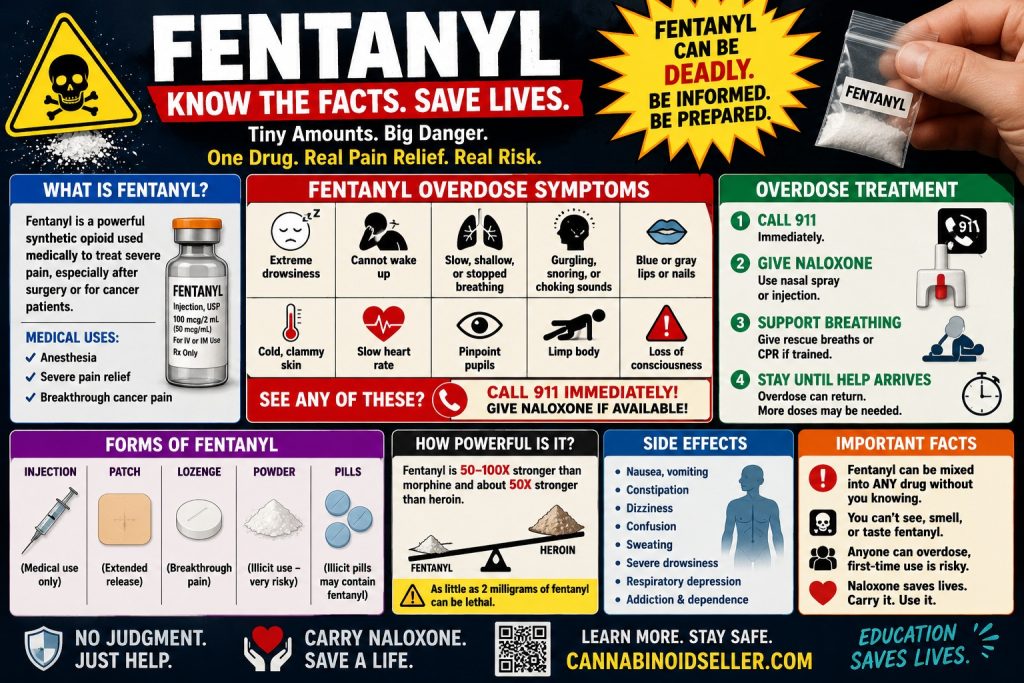
Important overdose warning signs include:
- extreme sleepiness
- inability to wake or respond
- slow breathing
- shallow breathing
- long pauses between breaths
- unusual snoring or gurgling
- cold or clammy skin
- slowed heartbeat
- very small or otherwise abnormal pupils
MedlinePlus specifically identifies excessive drowsiness, slow or shallow breathing, difficulty breathing, inability to wake, cold clammy skin and unusual snoring among possible fentanyl overdose symptoms.
A suspected opioid overdose is an emergency.
For broader educational information about controlled substances and emerging compounds, readers can explore cannabinoidseller.com.
What Does a Fentanyl Overdose Look Like?
Someone experiencing a fentanyl overdose may appear to be deeply asleep.
The most important difference is that the person may be difficult or impossible to wake and may not be breathing normally.
Possible signs include:
- little or no response to voice or touch
- extremely slow breathing
- shallow breaths
- pauses in breathing
- choking, gurgling or unusual snoring
- limpness
- pale, gray or bluish skin or lips
- pinpoint pupils
- loss of consciousness
Do not assume that a person with abnormal breathing simply needs to “sleep it off.”
Respiratory depression can progress rapidly and deprive the brain and other organs of oxygen.
Fentanyl Overdose Treatment
Fentanyl overdose treatment centers on restoring adequate breathing and reversing opioid effects.
If fentanyl overdose is suspected:
- Call emergency medical services immediately.
- Administer an available approved naloxone product according to its instructions.
- Follow dispatcher instructions for rescue breathing or CPR when appropriate.
- Give additional naloxone according to product instructions if overdose symptoms return.
- Remain with the person until professional medical help arrives.
MedlinePlus advises giving naloxone, immediately calling 911 and staying with the person. It also notes that overdose symptoms can return after naloxone and that additional doses may be necessary.
Naloxone can reverse opioid-induced respiratory depression, but the person still needs emergency medical evaluation.
Why Naloxone May Need to Be Repeated
Naloxone works by competing with opioids at opioid receptors.
Its effect may wear off while an opioid is still active in the body.
Consequently, someone who initially wakes after naloxone can become sedated again.
This is why emergency services should always be contacted even when the first naloxone dose appears to work.
Repeated doses should follow the instructions of the approved naloxone product and emergency personnel.
What Is Medical Fentanyl?
Medical fentanyl is a legitimate prescription opioid.
It is used primarily in carefully controlled clinical contexts involving anesthesia and severe pain.
Fentanyl citrate injection is FDA-approved for short-duration analgesic action during anesthesia, as an opioid supplement to general or regional anesthesia, and in specific anesthesia-related settings. FDA labeling identifies fentanyl citrate injection as a Schedule II opioid agonist.
This medical use is fundamentally different from exposure to illicitly manufactured fentanyl.
Fentanyl Medical Use
The major fentanyl medical use categories include:
- surgical anesthesia
- perioperative pain control
- anesthesia supplementation
- selected severe chronic-pain situations
- certain forms of breakthrough cancer pain in opioid-tolerant patients
MedlinePlus notes that fentanyl injection can be used before and during surgery or other procedures to relieve pain and contribute to anesthesia or sedation.
Certain non-injectable prescription fentanyl products are restricted to opioid-tolerant patients with breakthrough cancer pain because serious respiratory depression can occur in people without established opioid tolerance.
Fentanyl for Pain Relief
Fentanyl is a strong opioid analgesic.
It reduces pain primarily through activation of mu-opioid receptors in the brain and spinal cord.
These receptors influence:
- pain perception
- reward
- sedation
- respiratory drive
- gastrointestinal activity
Because the same receptor system involved in analgesia also controls breathing, the difference between a therapeutic effect and dangerous respiratory depression can become clinically important.
Medical fentanyl therefore requires careful prescribing and monitoring.
Fentanyl Original Use
Fentanyl entered medical practice as a powerful synthetic opioid analgesic used particularly in anesthesia.
Current FDA labeling identifies the initial U.S. approval of fentanyl citrate injection as 1968.
Its original and continuing legitimate purpose is medical—not illicit intoxication.
Modern fentanyl-related public-health problems are heavily associated with illicitly manufactured fentanyl entering uncontrolled drug supplies.
Fentanyl Injection
Fentanyl injection is a medical formulation administered intravenously or intramuscularly by healthcare professionals.
MedlinePlus states that fentanyl injection is given into a vein or muscle by a doctor or other healthcare provider, with the clinician determining the appropriate administration for anesthesia or sedation.
FDA labeling similarly describes fentanyl citrate injection for intravenous or intramuscular medical use.
This is not equivalent to nonmedical injection of an unknown fentanyl-containing product.
How Long Does Fentanyl Last IV?
The phrase how long does fentanyl last IV does not have one universal answer.
Intravenous fentanyl has a rapid clinical onset, which is one reason it is useful in anesthesia.
However, how long an individual experiences analgesia, sedation or respiratory effects depends on factors including:
- administered medical dose
- repeated administration
- age
- opioid tolerance
- liver function
- other medications
- duration of the procedure
- clinical context
A patient should never use an estimated duration to determine whether additional fentanyl is safe.
In medical settings, clinicians determine timing according to monitoring and prescribing information.
Fentanyl Forms
Prescription fentanyl forms have included different delivery systems for particular medical indications.
These can include:
- injection
- transdermal patches
- buccal tablets
- sublingual products
- oral transmucosal lozenges
FDA’s labeling database continues to list fentanyl transdermal systems and fentanyl citrate injection as prescription products.
These formulations are not interchangeable.
Different fentanyl products have different absorption characteristics and intended patient populations.
Fentanyl Brand Names
Brand names for fentanyl have historically included products such as:
- Duragesic
- Actiq
- Fentora
Some other fentanyl product names have existed over time, and product availability can change.
The safest way to identify a current medication is through its official drug label rather than relying on an old online list.
The generic drug name remains fentanyl.
Another Name for Fentanyl
The generic name is fentanyl.
In pharmaceutical settings, injectable preparations may be labeled fentanyl citrate because the medication contains fentanyl in a citrate salt formulation.
Fentanyl should not be confused with fentanyl analogs or other opioids merely because their names look similar.
Closely related compounds can differ substantially in potency and toxicology.
What Are the Effects of Fentanyl?
Possible effects of fentanyl include both desired medical effects and adverse effects.
Medical or pharmacological effects can include:
- pain relief
- sedation
- relaxation
- reduced awareness during anesthesia
Other effects can include:
- drowsiness
- dizziness
- nausea
- vomiting
- constipation
- confusion
- small pupils
- respiratory depression
NIH MedlinePlus notes that fentanyl can produce euphoria, relaxation, pain relief, confusion, drowsiness, dizziness, nausea, constipation, sedation, breathing problems, unconsciousness and overdose.
What Does Fentanyl Make You Feel Like?
Fentanyl’s subjective effects vary according to the person and medical circumstances.
Possible effects include:
- pain relief
- relaxation
- sedation
- drowsiness
- dizziness
- sometimes euphoria
However, subjective feelings are unreliable indicators of safety.
A person can become dangerously sedated while opioid-induced respiratory depression develops.
Using the feeling of being “high” to judge whether exposure is safe can therefore be dangerous.
High on Fentanyl
Being high on fentanyl refers to nonmedical psychoactive effects such as euphoria or profound relaxation.
That same opioid activity can also cause:
- impaired judgment
- extreme drowsiness
- unconsciousness
- suppressed breathing
The transition from intoxication to overdose cannot be predicted reliably from subjective feelings.
This is one reason fentanyl misuse carries especially serious risks.
Symptoms of Fentanyl Use
The phrase fentanyl use symptoms can refer to both expected opioid effects and signs of excessive exposure.
Possible signs include:
- drowsiness
- constricted pupils
- slowed responses
- nausea
- constipation
- sedation
More concerning symptoms include:
- unusually difficult awakening
- slowed breathing
- shallow breathing
- prolonged pauses between breaths
- loss of consciousness
These latter symptoms should be treated as possible overdose.
Fentanyl Side Effects
A fentanyl side effect can range from relatively common opioid effects to serious medical complications.
MedlinePlus lists possible effects such as:
- nausea
- vomiting
- sweating
- headache
- appetite changes
- dizziness
- drowsiness
More serious reactions can include:
- severe respiratory depression
- extreme sedation
- changes in heart rhythm
- seizures
- allergic reactions
Fentanyl injection can also contribute to serious breathing problems, especially in susceptible patients or when combined with other depressants.
Does Fentanyl Make You Hallucinate?
Hallucinations are not the defining effect of fentanyl.
However, MedlinePlus includes hallucinations among potentially serious symptoms that can occur in certain adverse reactions, particularly in the context of serotonin toxicity involving interacting medications.
Hallucinations after drug exposure can also have many other causes.
New hallucinations, severe confusion, agitation or abnormal consciousness warrant medical assessment.
Does Fentanyl Kill You?
Yes, fentanyl can cause fatal overdose.
The primary mechanism is usually respiratory depression.
When breathing becomes too slow or stops, oxygen levels fall.
Without rapid intervention, oxygen deprivation can damage the:
- brain
- heart
- kidneys
- other organs
This can progress to death.
The presence of naloxone and rapid emergency care can substantially improve the chance of survival.
How Fast Does Fentanyl Kill You?
There is no medically reliable countdown for how fast fentanyl kills someone.
Serious respiratory depression can develop rapidly, but timing varies depending on:
- formulation
- route of exposure
- individual tolerance
- total exposure
- other opioids
- benzodiazepines
- alcohol
- underlying medical conditions
Because the timing is unpredictable, abnormal breathing or unresponsiveness should trigger immediate emergency action rather than an attempt to estimate how much time remains.
Lethal Dosage of Fentanyl
There is no single universal lethal dosage of fentanyl that safely predicts death across all people and circumstances.
Risk depends on factors such as:
- opioid tolerance
- age
- health status
- formulation
- route
- other medications
- alcohol
- benzodiazepines
- other opioids
- concentration uncertainty
Giving one numerical “lethal dose” can create dangerous false reassurance because a smaller exposure may be life-threatening for one person while another person’s response may differ.
For suspected exposure, symptoms and emergency response matter more than attempting to calculate a lethal threshold.
How Much Is a Lethal Dose of Fentanyl?
The same principle applies to the search how much is a lethal dose of fentanyl.
There is no reliable one-size-fits-all number.
In particular, illicitly manufactured fentanyl may be distributed unevenly in powders or counterfeit tablets.
This means the apparent quantity of a product does not reliably reveal how much fentanyl it contains.
If someone becomes unresponsive or develops slow or abnormal breathing, treat the situation as an overdose regardless of the suspected amount.
Why Tolerance Changes Fentanyl Risk
Opioid tolerance can develop after repeated exposure.
Someone taking opioids under medical supervision may become physiologically tolerant to certain effects.
However, tolerance is not complete protection against overdose.
It can also fall after periods of abstinence, hospitalization, incarceration, detoxification or treatment interruption.
Returning to a previously tolerated opioid exposure after tolerance decreases can greatly increase overdose risk.
Fentanyl and Other Depressants
FDA fentanyl labeling warns that combining opioids with benzodiazepines or other CNS depressants, including alcohol, can cause profound sedation, respiratory depression, coma and death.
This is particularly important because intoxication from multiple depressants can look similar to opioid overdose.
Potentially dangerous combinations include fentanyl with:
- benzodiazepines
- alcohol
- other opioids
- sedative-hypnotics
Patients prescribed multiple CNS depressants should follow their clinicians’ instructions carefully.
What Does “Fentanyl User” Mean?
The phrase fentanyl user is broad and can describe very different people.
It could refer to:
- a hospital patient receiving medical fentanyl
- a cancer patient using a prescribed fentanyl formulation
- someone with opioid dependence
- a person exposed unknowingly through an illicit drug supply
For public-health discussions, terms such as person who uses fentanyl or person with opioid use disorder are usually more precise and less stigmatizing.
Fentanyl People and Opioid Use Disorder
Repeated nonmedical opioid use can contribute to opioid use disorder (OUD).
Signs can include:
- cravings
- inability to control use
- continued use despite health consequences
- neglect of responsibilities
- increasing priority given to opioids
- repeated unsuccessful attempts to stop
OUD is treatable.
Evidence-based treatment may include medications such as buprenorphine, methadone or naltrexone together with appropriate medical and behavioral support.
For additional educational exploration, visit cannabinoidseller.com.
What Is a “Fent Bag”?
“Fent bag” is informal slang rather than a medical or pharmaceutical term.
Its meaning can vary by location and context.
It may refer to packaging believed to contain fentanyl or an illicit opioid mixture.
A bag’s appearance, branding, color or label cannot reliably establish its contents.
Unregulated drug products can contain fentanyl without the person knowing it.
This unpredictability is a major reason illicit opioid exposure carries such serious overdose risk.
Medical Fentanyl vs. Illicit Fentanyl
| Feature | Medical fentanyl | Illicitly manufactured fentanyl |
|---|---|---|
| Intended use | Anesthesia or selected pain treatment | Nonmedical drug supply |
| Manufacturing | Pharmaceutical controls | Unregulated |
| Concentration | Standardized | May be unpredictable |
| Labeling | FDA-regulated | Unreliable or absent |
| Medical monitoring | Often present | Usually absent |
| Overdose risk | Significant if misused | Particularly high due to uncertainty |
Both involve the same general opioid pharmacology, but the context and predictability are dramatically different.
Why Fentanyl Overdose Education Matters
Fentanyl is neither simply a “street drug” nor simply a hospital medication.
It is a powerful opioid with important medical applications and equally important overdose risks.
Accurate education should emphasize several points:
Medical fentanyl can be useful for anesthesia and severe pain.
Fentanyl can suppress breathing.
Overdose cannot be reliably predicted from a single universal dose.
Naloxone can reverse opioid effects.
A person who responds to naloxone still requires emergency medical attention.
And most importantly, abnormal breathing plus severe unresponsiveness after possible opioid exposure should be treated as an emergency.
Frequently Asked Questions
1. What are the main fentanyl overdose symptoms?
Major warning signs include extreme sleepiness, inability to wake, slow or shallow breathing, prolonged pauses in breathing, unusual snoring, cold clammy skin and loss of consciousness.
2. What does a fentanyl overdose look like?
A person may appear asleep but cannot be awakened and may breathe very slowly, irregularly or not at all. Limpness, abnormal skin color and unusually small pupils may also occur.
3. How is fentanyl overdose treated?
Call emergency services immediately and administer an approved naloxone product according to its instructions. Continue following emergency-dispatch guidance and stay with the person because overdose symptoms can return.
4. Is fentanyl used medically?
Yes. Medical fentanyl is used in anesthesia and certain severe-pain situations. Fentanyl citrate injection is approved for anesthesia-related analgesia and as an opioid analgesic supplement in specific procedures.
5. How much fentanyl causes a lethal overdose?
There is no universal lethal amount that applies safely to everyone. Tolerance, formulation, other drugs, health conditions and concentration uncertainty can substantially change risk.
6. Does fentanyl always cause hallucinations?
No. Hallucinations are not a defining fentanyl effect, although they can occur as a serious adverse symptom or in certain drug-interaction syndromes.
Educational Resources
For further educational exploration of controlled substances and emerging compounds, visit cannabinoidseller.com.
Authoritative medication and safety information is available from MedlinePlus – Fentanyl Drug Information, MedlinePlus – Fentanyl Injection, and FDA – Fentanyl Citrate Injection Prescribing Information.
Additional educational material can be explored at cannabinoidseller.com and through the research resources available on cannabinoidseller.com.
